
Course Overview
This course will introduce students to ways that economists measure and evaluate the macroeconomy. We will cover a variety of topics such as gross domestic product, unemployment, money, and the theory of national income accounting. Students will learn to evaluate the health of a macroeconomy and learn to understand the measures often seen in the news. We will cover inflation and its effects, unemployment, recessions, trade and trade deficits, and what fiscal and monetary policy makers actually do.
An essential part of learning economics is doing economics and thus students will not just discuss these measures but calculate them themselves. To this end, critical thinking and problem-solving skills will be developed to tackle solving these problems. By the end of this course, students will be able to better engage with the news on important economic topics as well as calculate and explain what economists use to measure the macro economy.
All students who successfully complete the course will receive a Certificate of Completion and have the opportunity to request a Syracuse University credit transcript.
Learning Objectives
Gain a firm understanding of the principles of microeconomics. Topics include:
- Analyze markets using supply and demand curves, identify equilibrium prices and quantities, and apply elasticities to understand consumer and producer reactions to price changes.
- Measure a nation’s income using GDP and know the difference between nominal and real prices.
- Assess changes in the cost-of-living using measures such as the CPI.
- Utilizes the basic tools of finance, measure the value of money at different points in time, and evaluate risk.
- Examine the foundations of the labor market, how we measure unemployment, and how public policies and unions can affect the ability to get a job and the wage received.
- Understand what monetary policy is and the role of the Federal Reserve with its Dual Mandate.
- Understand the basic aspects and determinants of trade and international flows of goods and capital, with tools such as exchange rates and purchasing power.
- Evaluate how monetary and fiscal policies affect aggregate demand and the tradeoff that policymakers face in balancing unemployment and inflation.
Course Information
Course Prefix and Number: ECN 102
Format: On Campus (at Syracuse University)
Eligibility: Students must be of rising high school junior or senior status – or a 2026 high school graduate.
Credit: 3 Credits
Grading: A-F
Cost:
- Residential: $5,595
- Commuter: $4,624
Program rates are subject to change and will be approved by the board of trustees. Discounts and scholarships are also available.
Program Information
Summer College – On Campus: Experience what college is really like: take a college-level course, live in a residence hall, have meals with friends in a dining hall, and participate in activities and events on campus.
Course Dates and Details
| Program | Course Dates | Synchronous Class Time (Eastern Time) | Credit/Noncredit |
|---|---|---|---|
| Summer College – On Campus | 2-Week Session II: Sunday, July 19 – Friday, July 31, 2026 | MTWThF; 9 a.m. – 1 p.m. | 3 Credits |
To see if this course is ‘open,’ refer to the full course catalog.
Required Materials
Required Supplies:
It is recommended that you bring a simple calculator (not the one on your phone).
A notebook or tablet for note taking is preferred. Computers in class can be distracting, and research shows that handwriting notes is more effective anyway!
Required Textbook:
- Gregory Mankiw, Principles of Macroeconomics, 10th ed.
Please know that any supply purchases are not included in the overall tuition fee. Students will need to budget for additional course supplies, textbooks, supply kits, etc.
Typical Day
Tentative Schedule
Classes will be held every weekday from 9 a.m. to 1 p.m. with an approximately 15–20-minute break around 11 am. After class, there will be an office hour with the TA and instructor for students who have additional questions. There will also be a brief homework assignment that will be due before the next class to help further students understanding of the course material.
When class is over, and on weekends, students can look forward to various Summer College – On Campus activities to meet and connect with other students! Check out our On Campus Experience page for more information!
Faculty Bio
Daniel Solis
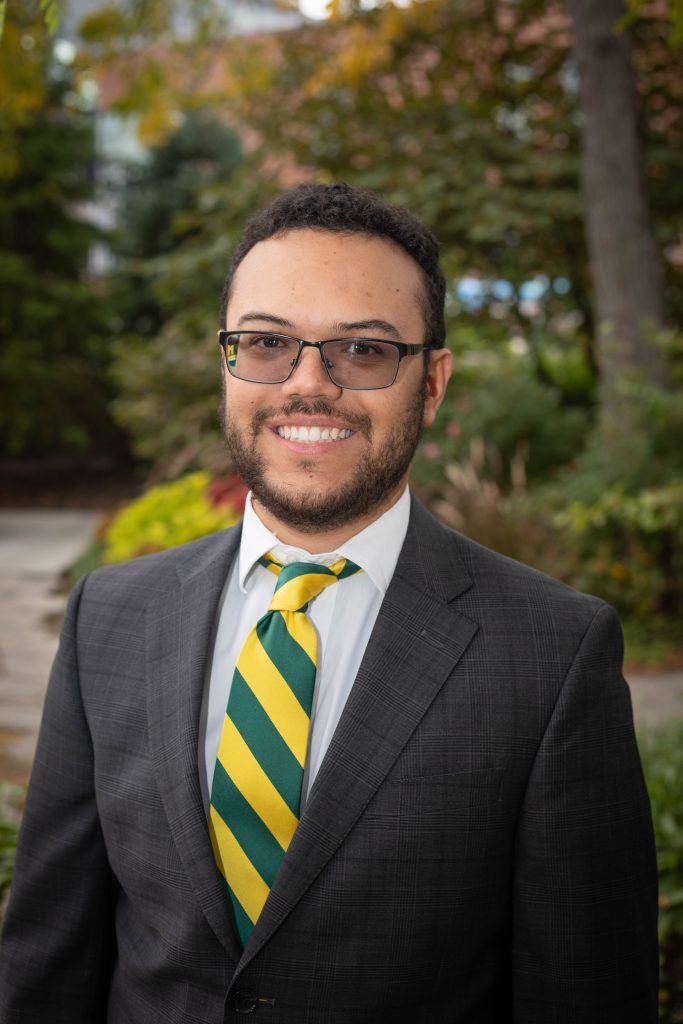
Daniel is currently an Economics Ph.D. student at Syracuse University. He received a Bachelor of Arts from Siena University (formerly Siena College) where he double majored in Economics and Political Science. Daniel is interested in questions surrounding poverty and food insecurity and ways in which they can be combated, whether in the public, private, or non-profit sectors. He is also interested in the effects of public policies and understanding the ways in which such policies can affect individual and firm decision making.