
Course Overview
This course provides students with an introduction to the fundamental concepts, methods, and technologies in applied data science. Students will gain exposure to how data is organized, managed, curated, preserved, and analyzed in both professional and academic contexts. Core themes include data management practices, ethics, data quality control, and the communication of insights for effective decision-making.
Through a combination of lectures, labs, and a group project, students will develop hands-on skills in R programming and applied statistics, while exploring advanced topics such as data visualization, text mining, and machine learning. Weekly labs reinforce lecture concepts, giving students opportunities to practice coding, transform and clean data, and conduct real-world analyses. The semester culminates in a final project where students apply what they have learned to analyze a real-world dataset and deliver actionable insights.
All students who successfully complete the course will receive a Certificate of Completion and have the opportunity to request a Syracuse University credit transcript.
Learning Objectives
By the end of this course, students will be able to:
- Explain essential concepts and characteristics of data
- Apply scripting in R and RStudio for data management and analysis.
- Perform data cleaning, screening, transformation, linking, and visualization.
- Communicate analytical results effectively to decision-makers.
- Identify ethical challenges in data science across different domains.
- Design solutions by identifying appropriate data sources and analysis methods.
- Manage data throughout the project lifecycle, from collection to analysis.
Course Information
Course Prefix and Number: IST 387
Format: On Campus (at Syracuse University)
Eligibility: Students must be of rising high school junior or senior status – or a 2026 high school graduate.
Credit: 3 Credits
Grading: A-F
Cost:
- Residential: $5,595
- Commuter: $4,624
Program rates are subject to change and will be approved by the board of trustees. Discounts and scholarships are also available.
Program Information
Summer College – On Campus: Experience what college is really like: take a college-level course, live in a residence hall, have meals with friends in a dining hall, and participate in activities and events on campus.
Course Dates and Details
| Program | Course Dates | Synchronous Class Time (Eastern Time) | Credit/Noncredit |
|---|---|---|---|
| Summer College – On Campus | 2-Week Session II: Sunday, July 19 – Friday, July 31, 2026 | MTWThF; 9 a.m. – 1 p.m. | 3 Credits |
To see if this course is ‘open,’ refer to the full course catalog.
Required Supplies
Students must bring a functioning laptop to every class and lab. The laptop should have R and RStudio installed or access to posit. Cloud for running R scripts. Internet Access: Required for accessing course materials, submitting assignments, and working with cloud-based tools. Optional Reference: Data Science for Business with R by Jeffrey Saltz and Jeffrey Stanton (2021).
Additional Student Requirements
In addition to the base requirements (application essay, transcript, and class standing), students should meet the following criteria:
- Mathematical Background: Familiarity with high school–level algebra, geometry, and basic statistics.
- Computer Skills: Comfort with using spreadsheets (e.g., Excel or Google Sheets) and basic file management.
- Interest in Data Science: Curiosity about applying data science in fields such as business, science, health, or social science.
- Technology Access: Ability to bring a personal laptop with R and RStudio (or posit.Cloud) installed.
No portfolio, audition, or prior coding experience is required. The course is designed to be accessible to motivated students who are eager to learn.
Typical Day
Tentative Schedule
Morning Session (Lecture: 1.5 hours)
- Introduction to the day’s topic, including theory and real-world applications.
- Coding demonstrations in R to illustrate concepts.
- Class discussion and Q&A to reinforce understanding. Afternoon Session (PM: Lab + Homework Practice: 2.5 hours)
Afternoon Session (Lab + Homework Practice: 2.5 hours)
- Guided lab exercises applying lecture material using R.
- Hands-on coding practice.
- Time to begin homework assignments with instructor support.
End-of-day wrap-up to address questions and highlight key takeaways.
When class is over, and on weekends, students can look forward to various Summer College – On Campus activities to meet and connect with other students! Check out our On Campus Experience page for more information!
Faculty Bios
Neiva Fortes
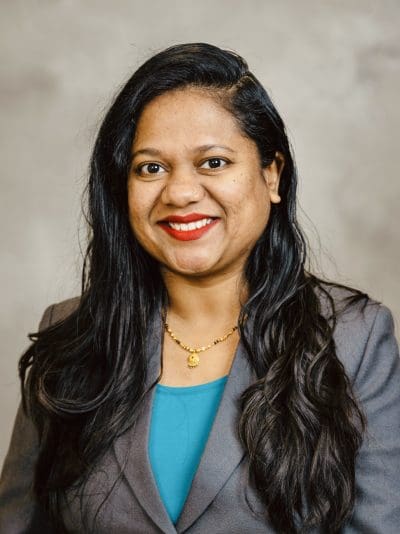
Dr. Preeti Mahaveer Jagadev is an Assistant Teaching Professor at Syracuse University’s School of Information Studies (iSchool), where she specializes in artificial intelligence. She earned her Ph.D. from the National Institute of Technology and completed a postdoctoral fellowship at the University of Michigan.
At the iSchool, Dr. Jagadev is dedicated to fostering an inclusive learning environment and advancing interdisciplinary research. Her work bridges the gap between technology and healthcare, reflecting a forward-thinking approach to education and innovation.